I'm annoyed that I only got two down, but here they are.
Hero's Journey:
https://tdbucaanimation.blogspot.com/2019/12/film-review-heros-journey-guardians-of.html
Three Act Structure:
https://tdbucaanimation.blogspot.com/2019/12/film-review-three-act-structure-hot.html
Even though they're not gonna count towards my grade now, I'll still complete the other 3 reviews over Christmas.

Showing posts with label Film Review. Show all posts
Showing posts with label Film Review. Show all posts
Friday, 13 December 2019

Film Review - The Hero's Journey / Guardians of the Galaxy (2014)
The Monomyth, or the Hero’s Journey as it is more commonly known as, is a simple narrative structure used in storytelling throughout history. While he obviously didn’t create the concept, Joseph Campbell gave a detailed set of events that create a hero’s journey in his book, ‘The Hero with a Thousand Faces’ (1949).
Campbell suggested that any hero’s journey story could be broken down into this list of events.
Act 1
Start: Ordinary World - Where the hero starts.
1. Call to Adventure - The hero is faced with something new that calls them to adventure.
2. Refusal of Call - The hero refuses the call.
3. Supernatural Aid - The hero meets the mentor.
4. Crossing First Threshold - The hero finally agrees to go on an adventure. The threshold is usually blocked by a ‘guardian’.
Act 2
5. Belly of the Whale - The hero is thrust into their first proper confrontation with the villains. The hero escapes, but barley.
6. Road of Trials - The mentor begins to show the hero their strengths and weaknesses.
7. Meeting the Goddess - Can be a physical being, object or an idea. This is what gives the hero drive to complete the quest.
8. Temptation - The hero may become conflicted over their ‘goddess’.
9. Atonement with the Father - The hero becomes conflicted over authority figures in their lives.
10. Apotheosis - Sometimes the death of the mentor. The hero has a realisation that changes how they approach the situation.
11. The Ultimate Boon - The hero completes the goal set by the call to adventure, but their quest is not over yet.
12. Refusal of Return - The hero has a new goal and refuses to return to their ordinary world.
Act 3
13. Magic Flight - The hero faces off against the villain.
14. Rescue from Without - Others that the hero has met along the way come to the hero’s aid.
15. Crossing the Return Threshold - The hero wins.
16. Master of two Worlds - The hero has become the master of themselves, their quest and their ordinary world.
17. Freedom to Live - The hero has truly become a hero.
An alternate version of this list was created by Chris Vogler in ‘The Writer’s Journey’ (1992). This version of the Monomyth was created with film in mind, hence why it is shorter.
Act 1
1. Ordinary World - Where the hero starts.
2. The Call to Adventure - The hero is faced with something new that calls them to adventure.
3. Refusal of the Call - The hero refuses the call.
4. Meeting the Mentor - The hero meets the mentor. The same as ‘Supernatural Aid’.
5. Crossing the Threshold - The hero finally agrees to go on an adventure. The threshold is usually blocked by a ‘guardian’.
Act 2
6. Tests, Allies, & Enemies - The hero learns who their allies and enemies are. They are also tested in various ways. This is ‘Belly of the Whale’ and ‘Road of Trails’ rolled into one category.
7. Approach - The hero is on their way to their goal.
8. The Ordeal, Death & Rebirth - This is when the hero is almost at their goal, but complications arise. This category contains ‘Meeting the goddess’, ‘Temptation’, ‘Atonement with the Father’, and ‘Apotheosis’.
9. The Reward, Seizing the Sword - The hero completes the goal set by the call to adventure, but their quest is not over yet. Same as ‘The Ultimate Boon’
Act 3
10. The Road Back - The hero has a new goal and refuses to return to their ordinary world. Same as ‘Refusal of Return’.
11. Resurrection - The hero must face off against the villain. This category contains ‘Magic Flight’, ‘Rescue from Without’ and ‘Crossing the Return Threshold’.
12. Return with Elixir - The hero has won. Same as ‘Master of two worlds’ and ‘Freedom to live’.
Of course, not every “Hero’s Journey” film follows these events exactly, so may deviate quite far, but these lists are just a guide that can be used to better understand storytelling.
To explain the theory, here’s James Gunn’s ‘Guardians of the Galaxy’ (2014) reviewed through the lens of The Hero’s Journey.
 |
| Fig. 1. Guardians of the Galaxy Poster (2014) |
Guardians of the Galaxy (2014) is a film based on a Marvel comic of the same name. The film follows a man named Peter Quill (Chris Pratt) as he slowly grows as character, changing from a common criminal to hero of the galaxy. This film does follow the hero’s journey, even if a few parts are moved around or missing for more coherent storytelling.
Act 1
Ordinary World
You could argue that there are two ordinary worlds seen at the start of Guardians of the Galaxy. There is the ordinary world on Earth, which is shown as a prologue sequence. In this scene we are introduced to young Peter Quill as he is in hospital, beside his dying mother. As she dies, Peter runs out of the building and is then abducted by aliens. This brings us to the second ordinary world and the one that is referenced throughout the film. This ordinary world is not the actual location that the film’s title sequence takes place in, but the lifestyle that adult Peter Quill lives, he is a thief. Specifically, a thief that has gone rouge from a band of space pirates.
Call to Adventure
Quill’s current objective is to collect a metal orb from a destroyed civilisation. This orb serves as the mcguffin for the film and is what kickstarts Quill’s hero journey. As he collects it, he is jumped by a group of evil soldiers. This prompts Quill to use all many of gadgets to escape.
Refusal of Call
Quill doesn’t want the orb for any personal reasons, he wants it so he can sell it. When he arrives on the planet Xandar, he tries to sell the orb. However, he accidentally let’s slip that a group of soldiers were also after the orb. The soldiers were actually a small group sent by the main antagonist of the film Ronan the Accuser. The broker, not wanting anything to do with Ronan, refuses to buy from Quill and pushes him out of his shop.
Supernatural Aid
There is no present character that represents Supernatural Aid in this film. There are some elements of Supernatural Aid that are explored in Guardians of the Galaxy 2 (2017), but there is no actual mentor figure in the first film. That isn’t to say there isn’t a father figure, however. The leader of the space pirates, Yondu, serves as Quill’s father figure in both films. However, his character is more explored in the sequel, whereas in this film he is seen more as an obstacle and reluctant ally.
Act 2
Crossing First Threshold
After getting kicked out of the shop, Quill gets into a fight with a woman named Gamora over the orb. The fight then extends out to include a genetically engineered raccoon, named Rocket, and a talking tree, named Groot. All four characters get arrested. You could argue that these characters ending up in prison is the first threshold, making Gamora, Rocket and Groot the threshold guardians.
Belly of the Whale
In prison the group are faced with some of the worst criminals in the galaxy and a collection of guards that don’t care what the criminals do to each other. It is here that the group meet Drax the Destroyer. He plans to kill Gamora, as revenge for Gamora’s boss, Ronan, killing his wife and daughter. It is here where Quill intervenes to save Gamora and explains to Drax that Gamora has already betrayed Ronan and that he shouldn’t kill her. Drax backs down, for now.
Road of Trials
The trails the group must face come into play with their prison escape. They become a team to overpower the guards and escape. Along with Drax, the team manage to escape, however Quil goes back into the prison to collect his belongings, including the orb.
Meeting the Goddess
The team, now consisting of Quill, Gamora, Rocket, Groot and Drax, plan to sell the orb to a man named The Collector. So, they use Quill’s spaceship and travel to a “planet” known as Knowhere. When they reach Knowhere and finally meet The Collector, he shows them that the orb is in fact an infinity stone, one of the most powerful mcguffins items in the galaxy. The infinity stone is now the narrative’s goddess.
Temptation
None of the characters know what to do with the stone. Since it is extremely dangerous it is suggested that they take the stone to an organisation called Nova Corp., which just so happens to be the same people that arrested them earlier or they give the stone to Ronan and their lives be spared. However, they are not given much time as new factions appear at Knowhere.
Atonement with the Father
One of the factions is Yondu and his pirates. They have been chasing Quill for the entirety of the film and they want him to answer for his crime of abandoning them.
Apotheosis
The other faction to arrive is Ronan and his army. Drax, wanting revenge called Ronan himself for a duel. However, Ronan effortlessly incapacitates Drax and immediately goes after the stone. Ronan retrieves the stone and sets out to destroy Xandar. Quill and Gamora are captured by Youndu. Rocket, Groot and Drax (after being revived by Groot) plan to rescue Quill and Gamora, showing a change in perspective for these usually quite selfish characters.
The Ultimate Boon
There is no Ultimate Boon as the heroes fail. They lost the stone and now the universe is in danger.
Refusal of Return
After reasoning with Yondu, the team begin to plan how they are going to save Xandar from Ronan’s wrath. This shows clear development with the characters, going from a group of criminals, to a group of people ready to save the world.
Act 3
Magic Flight
The heroes take to their spaceships and they attack Ronan’s giant command ship head on as it approaches the planet’s surface. During the assault the Guardians manage to board Ronan’s ship and challenge Ronan himself.
Rescue from Without
Assistance came to the heroes in the form of both the pirates and Nova Corp. coming in to help keep Ronan’s ship at bay.
Crossing the Return Threshold
Ronan finally lands on the planet surface, but before he can do anything Quill takes the infinity stone from him. The Guardians then use the power of the stones to destroy Ronan, saving the galaxy.
Master of two Worlds
Peter Quill and the rest of the Guardians have now become heroes and are therefore masters of both heroism and the criminal world.
Freedom to Live
The Nova Corps. Thank the Guardians for their service and they are now free to go do whatever they like.
Film Review - Three Act Structure / Hot Fuzz (2009)
Once defined by Ancient Greek Philosopher Aristotle, the three act structure is a way of telling stories ever since stories have been a thing. A more recent definition comes from Syd Field’s Screenplay (1979). Field’s paradigm is the structure this review will be working with to explore the story of Edgar Wright’s Hot Fuzz (2009).
This is the biggest point of a film. It is usually a final confrontation between the heroes and villains. In Hot Fuzz, it's when Angel walks into the police station, takes a bunch of weapons he had confiscated earlier in the film and then storms the village. He and Danny quickly dispatch of most of the murderers, but they end up having a few major show downs with village figure heads, including the police inspector. After a long fight, Angel emerges victorious.
Hot Fuzz is an example of a partial ending. All plot lines are resolved, but its still open for the characters to continue.
The other types of ending are: Open endings, when the ending of a story is left ambiguous; and closed endings, when the ending is definitive and no more stories can take place.
It is also an example of an arc plot. An arc plot is a story that tells a coherent and consistent story.
The other types of plot are: Anti-plots, plots that do things at seemingly random; and Mini plots, which are smaller stories told within one much larger story.
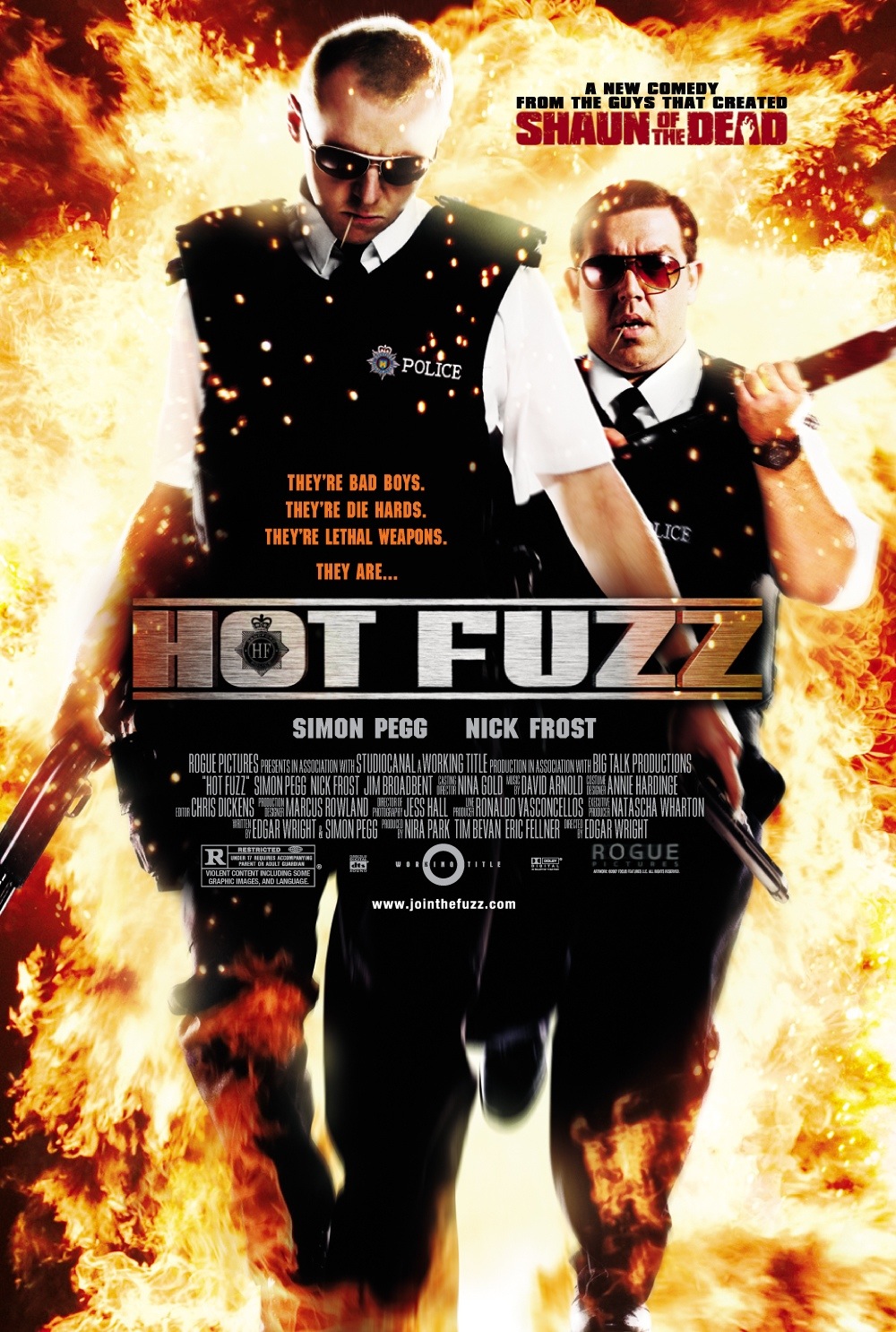 |
| Fig. 1. Hot Fuzz Poster (2009) |
Act 1
Exposition
This is the part of a film where it introduces the main character. In the case of Hot Fuzz, this is when the film introduces PC Nicholas Angel (Simon Pegg) and then proceeds to explain all his accomplishments and his job in the Police Service.Inciting Incident
This is the moment in a film that sets the plot in motion. In Hot Fuzz, it's when Angel gets promoted to sergeant, but not in London, he is instead being transferred to Sandford, Gloucestershire. The few scenes are him slowly getting used to life in the country, while still trying to uphold his image of the law.Plot Point #1
This is when a new point is made in the plot that becomes the main focus of the film. In Hot Fuzz, this is when two actors are found dead. It is said to be an accident, but Angel has his suspensions and believes it could be murder.Act 2
Obstacles
This is when the challenges the characters face get even more difficult to overcome. Moving on in Hot Fuzz, more and more deaths keep happening and Angel gets more and more suspicious until...Mid Point
This is the point of a film when everything starts to go wrong. In Hot Fuzz this is when Angel finally comes out and says that he thinks all the deaths are murders. No one believes him and he can't prove anything, so he falls into a state of depression.Plot Point #2
This is when something, usually connected to plot point #1, happens that changes the course of the film. This happens in Hot Fuzz when someone is sent to kill Angel. The attacker fails and the sergeant is lead to the villains headquarters. There he finds that all of the village leaders are in a murderous cult to control the village. Angel confronts them but is chased off, only just saved by his friend, Danny (Nick Frost).Act 3
Climax
Twist
This is often when there is a surprise villain at the end of a film. In Hot Fuzz's case, all the police are sitting around doing paperwork, when the last village leader walks in with a blunderbuss. He shoots Danny, but is then kicked into a sea-mine, which was being stored in the station. The bomb explodes, destroying the station.Resolution
This is the end of a story, where usually all plot lines are addressed and concluded. In Hot Fuzz, this is when Angel is now in charge of the Sandford police service and the conspiracy is behind him; he & Danny go out on patrol.Hot Fuzz is an example of a partial ending. All plot lines are resolved, but its still open for the characters to continue.
The other types of ending are: Open endings, when the ending of a story is left ambiguous; and closed endings, when the ending is definitive and no more stories can take place.
It is also an example of an arc plot. An arc plot is a story that tells a coherent and consistent story.
The other types of plot are: Anti-plots, plots that do things at seemingly random; and Mini plots, which are smaller stories told within one much larger story.
Thursday, 7 March 2019
Film Review: Black Narcissus
Michael Powell and Emeric Pressburger’s Black Narcissus (1947) is
a film about a group of nuns up in the Himalayas. The story is filled with
hidden meanings and symbolism. This review will be using the theory of
semiotics to take a deeper look into the nun characters of the film, mainly
focusing on the colours and lighting. Key sources in this review include: Charles
W. Morris’ Signs, Language, and Behavior (1946), Craig McCall’s
documentary Painting with Light
(2007) and Jacob Olesen’s Color-Meanings.com.
The main question of this review is: How does colour and lighting affect the
way each character is presented and interpreted.
Black Narcissus starts with a small group of nuns moving
into the Himalayas to create a school out of an old harem building. The task
however turns out to more difficult than they had anticipated as characters
such as Mr. Dean and Kanchi, as well as the environment itself, start bringing
up repressed thoughts and feelings within the nuns. Things come to ahead when
one of the nuns, Sister Ruth, becomes obsessively infatuated with Mr. Dean and becomes
incredibly jealous of Sister Clodagh, who has her
own issues relating to Mr. Dean. The film ends with Ruth trying to kill
Clodagh, only for Ruth to fall to her own death. Afterwards, the remaining nuns
pack up and leave.
As shown here in Figure 2, most of the nuns and the child
are shown in bright, natural light. Thinking of semantics and pragmatics, clear
light illuminating women of faith and children can easily been seen as
signifying purity and innocence. The opposite, however could be said for Sister
Ruth (Kathleen Byron), shrouded in darkness on the left.
“He [Jack Cardiff] gave me half of my performance with the lighting.” (Byron, 2007)
The character of Sister Ruth is one that is shown to be very dangerous. While she was still a nun, Sister Ruth was almost always seen in shadow. This could be interpreted as her having a dark, menacing presence. As shadows and darkness become more and more prominent in the film, showing Ruth’s downward spiral into madness, it starts to engulf the environment around the other characters, symbolising how they are each slowly falling to their repressed desires.
As seen here in Figure 3, Sister Philippa (Flora Robson) has
a lot of light blue in her clothing, “Light blue is associated with health, healing, tranquillity, understanding, and softness.” (QSX Software Group, 2002). In the
scene where she appears as this, she has been planting flowers when she was
supposed to be planting vegetables. Throughout history flowers have been given
romantic and sexual symbolism, which in this case presents Sister Philippa’s
repression of her sexual urges. After this she is the first nun to leave.
Sister Clodagh (Deborah Kerr) is the Sister Superior of the group
and therefore has to act like a model nun. For the most part she does, she
resists her attraction to Mr. Dean and she tries her hardest to not let her
memories of a failed relationship at home distracter from her duties. With her
efforts to stay emotional balanced, she begins to wear a little bit of grey (As
can be seen around her hands in Figure 4). Grey can be interpreted as an
unemotional and detached colour. “Light grey is relaxing and soothing. It can help in difficult life
situations. Dark grey is
serious, solemn and inflexible. It is associated with self-denial and
self-discipline.” (Olesen). Wearing grey signifies her attempts to stay in
control of her urges. The same, however, cannot be said for the character of
Sister Ruth.
Red
becomes Sister Ruth's main colour in the later portions of the film. “It is a warm colour
that evokes a strong sense of passion, lust, sex, energy, blood and war.”
(Olesen). She uses red in many different ways: she uses it to intimidate Sister
Clodagh before leaving and she uses it to express her lust for Mr Dean. Red is
also used to signify her hatred of Sister Clodagh.
Red
is used in conjunction with her dark lighting to create a truly evil atmosphere
around the character.
In
her final scene, her red dress has darkened to the point of looking black. “Black
is a colour that is often used to portray something evil, depressing, scary and
even death in the Western civilization.” (Olesen). Her appearance in black for
this scene can signify a couple different things: 1. that she is too far gone
and cannot be redeemed and 2. this is the scene where she dies. In this scene
she is truly seen as an opposite to Sister Clodagh with her white and blue
clashing with Ruth’s black and red.
Semiotics is the study of signs and symbols. The theory looks at
various elements such shapes, colours and objects to judge the emotions and
meanings that they represent. Some semioticians believed that connecting signs
with other elements allowed for better understanding of said signs. Charles W.
Morris broke the concept down into three categories:
- Pragmatics - “the relation of signs to interpreters,”
- Semantics - “the relations of signs to the objects to which the signs are applicable,”
- Synatactics - “the formal relations to one another.” (Morris, 1946: 217)
All three of these sub-theories are important as they can be
used to show a sign or symbol in different light depending on who is
interpreting the sign, what objects are associated with the sign and what other
signs are also connected with it.
 |
| Fig. 1. Black Narcissus Poster (1947) |
Lighting was a very important element used
throughout the film. Inspired by artists like Vermeer and Rembrandt, Jack
Cardiff, the cinematographer on Black Narcissus, wanted to keep the lighting
quite clear and simple (Cardiff, 2007). The simplicity of the lighting used
allows the viewer to grasp what they should be feeling at certain times and
with different characters.
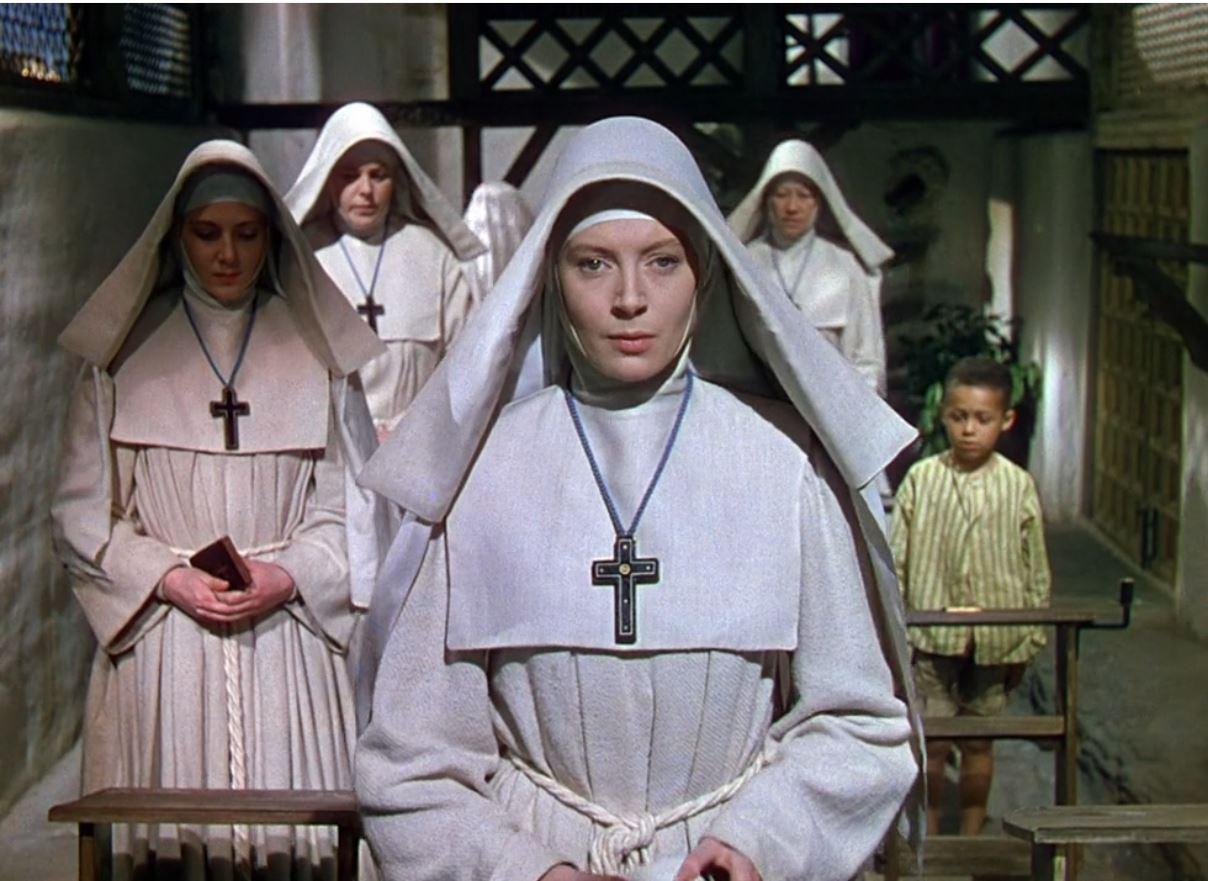 |
| Fig. 2. The nuns praying (1947) |
“He [Jack Cardiff] gave me half of my performance with the lighting.” (Byron, 2007)
The character of Sister Ruth is one that is shown to be very dangerous. While she was still a nun, Sister Ruth was almost always seen in shadow. This could be interpreted as her having a dark, menacing presence. As shadows and darkness become more and more prominent in the film, showing Ruth’s downward spiral into madness, it starts to engulf the environment around the other characters, symbolising how they are each slowly falling to their repressed desires.
Colour is another element used throughout the film.
The nuns are shown with a mostly white colour scheme with a little bit of blue
hanging around their necks. “The colour white is usually
associated with being pure and almost heavenly.” (Olesen). White is a very
important colour to be associated with the nuns with its symbolism of purity,
innocence and spirituality. “It is a colour that symbolizes loyalty, strength,
wisdom and trust. Blue colour meaning is also known to have a calming
effect on the psyche.” (Olesen). The blue seen hanging the cross in the nuns apparel
signifies their loyalty to their religion as well as presenting to others that
they are trustworthy individuals. There are three nuns that break this set
colour scheme at later parts of the film.
 |
| Fig. 3. Sister Philippa (1947) |
 |
| Fig. 4. Sister Clodagh (1947) |
In
terms of colour, Sister Ruth is depict the same as the other nuns for much of the
film, however something is always show to be off with her. Her introduction to
the film shows her covered in blood, this is heavy foreshadowing as to both how
she appears and what happens to her at the end of the film.
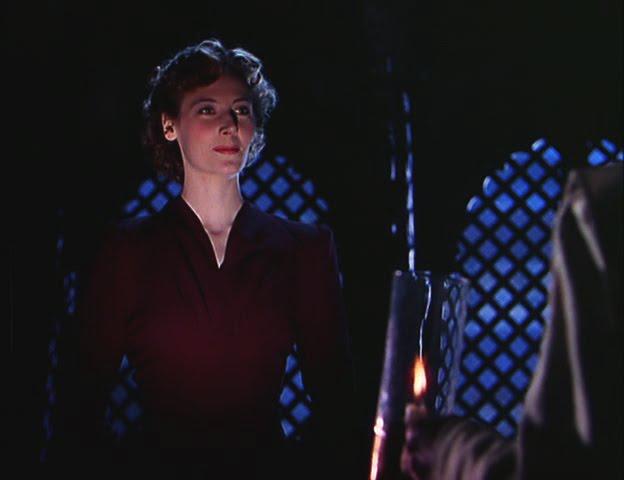 |
| Fig. 5. Ruth (1947) |
 |
| Fig. 6. Sister Ruth (1947) |
 |
| Fig. 7. Mad Ruth (1947) |
Black
Narcissus is a film that uses colour, lighting and other signs to show the
films themes and emotions. By understanding and using the theory of semiotics,
interpreters can see the meanings and connections of these signs, allowing for
a more enriching viewer experience.
Bibliography
Morris, C. (1946) Signs, Language, and Behavior. [Online] At: https://www.scribd.com/document/354976225/Morris-Charles-Signs-language-and-behavior-1946-Harvard (Accessed on 2nd March 2019)
Olesen,
J. (Unknown) Color Meanings. At: https://www.color-meanings.com/
(Accessed on 3rd March 2019)
Painting with Light. (2007) [Documentary] At: https://www.youtube.com/watch?v=tuwU_f42dUk (Accessed on 9th November
2018)
2018)
QSX Software Group (2002) Color Meaning. At: http://www.color-wheel-pro.com/color-meaning.html (Accessed on 9th November 2018)
Illustration List
Figure 1. Black Narcissus Poster. (1947) [Poster] At: https://www.cinematerial.com/movies/black-narcissus-i39192/p/7tp9zyh4 (Accessed on 02.02.19)
Figure 2. The nuns praying. (1947) From: Black Narcissus, Directed by: Michael Powell and Emeric Pressburger. [Film Still] United Kingdom: The Archers. At: https://lecinemadreams.blogspot.com/2016/07/black-narcissus-1947.html (Accessed on 02.03.19)
Figure 3. Sister Philippa. (1947) From: Black Narcissus, Directed by: Michael Powell and Emeric Pressburger. [Film Still] United Kingdom: The Archers. At: https://www.pinterest.co.uk/pin/359584351479590792/?autologin=true (Accessed on 03.03.19)
Figure 4. Sister Clodagh. (1947) From: Black Narcissus, Directed by: Michael Powell and Emeric Pressburger. [Film Still] United Kingdom: The Archers. At: https://offscreen.com/view/strangers_in_strange_lands (Accessed on 03.03.19)
Figure 5. Ruth. (1947) From: Black Narcissus, Directed by: Michael Powell and Emeric Pressburger. [Film Still] United Kingdom: The Archers. At: https://www.alternateending.com/blog/best-shot-black-narcissus (Accessed on 03.03.19)
Figure 6. Sister Ruth. (1947) From: Black Narcissus, Directed by: Michael Powell and Emeric Pressburger. [Film Still] United Kingdom: The Archers. At: https://backlots.net/2012/08/13/religious-thematic-elements-in-black-narcissus-1947/ (Accessed on 03.03.19)
Figure 7. Mad Ruth. (1947) From: Black Narcissus, Directed by: Michael Powell and Emeric
Pressburger. [Film Still] United Kingdom: The Archers. At: https://filmschoolrejects.com/allure-shock-black-narcissus-70-years-later/ (Accessed on 03.03.19)
Pressburger. [Film Still] United Kingdom: The Archers. At: https://filmschoolrejects.com/allure-shock-black-narcissus-70-years-later/ (Accessed on 03.03.19)
Thursday, 13 December 2018
Film Review: Alien
Ridley Scott’s Alien (1979) is a film that features numerous transhuman elements. This review will be exploring transhumanism and how it connects to Alien. The key sources are: Julian Huxley’s Religion without Revelation (1927), Nick Bostrom’s A History of Transhuman Thought (2005) and H. R. Giger’s personal website. The key points covered: What is transhumanism? Who is H. R. Giger? And how does Giger’s work on Alien show transhumanism?
Transhumanism is the futurist belief that humanity can transcend its current and natural limitations, usually with the assistance of technology. “The human species can, if it wishes, transcend itself – not just sporadically, an individual here in one way, an individual there in another way – but in its entirety, as humanity. We need a name for this new belief. Perhaps transhumanism will serve: man remaining man, but transcending himself, by realizing new possibilities of and for his human nature.” (Huxley, 1927, quoted from Hughes, 2004). Some believe it to human nature to want to evolve and become more than what we already are. While there is debate as to where the term first came from, it is largely agreed that many of the foundational ideas come from Sir Julian Sorell Huxley. The basic idea is that transhumanists want to advance the human race in anyway possible. This is something reflected in the work of H. R. Giger.
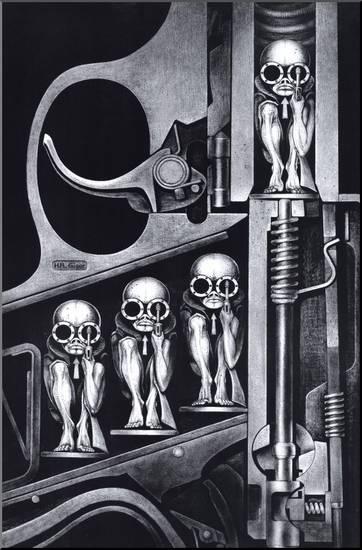
Hans Ruedi Giger was a Swiss artist that created many unusual art pieces. “H.R. Giger’s fusions of human and machine can be profoundly disturbing, yet somehow beautiful, alien and recognizable all at once.” (Bellot, 2017) Giger’s work showed a bizarre relationship between human and machine, which indicates to him being a transhumanist.
In 1977, Giger compiled a collection of his work into a book, titled Necronomicon (After the fictional Lovecraftian book of the same name). The Necronomicon contained many different pieces of art, including Necronom IV (1976), which became the inspiration for Ridley Scott’s Alien.
Alien is a film set in the far future. The crew of the spaceship Nostromo find a strange structure, inside they the remains of a long dead alien, called the space jockey. Further inside they find a large batch of eggs. One of these eggs hatch and a facehugger attaches itself to a crew member. They take him back to the ship to remove the creature, which they are unable to do. Eventually it detaches and everything seems to go back to normal, until a chestburster rips out of him and escapes somewhere into the ship. The rest of the film becomes a 3 way conflict between Ash (an android with the hidden mission to bring back alien life), the remaining crew and the alien Xenomorph.
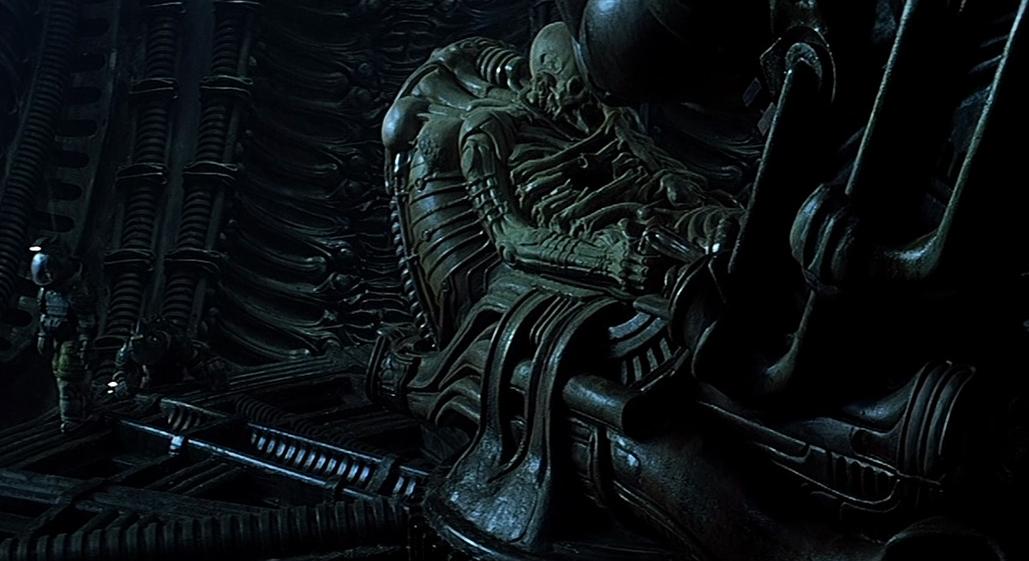
There are numerous transhuman elements in the film, starting with the alien environment and the space jockey.
To keep the designs consistent, Scott hired Giger to be the head of designing everything non-human in the film. The derelict ship has a very peculiar and otherworldly feel to it with the unusual patterns and structures. The space jockey also shows something very distinctly ‘other’. But it is also shown in a way that it could have been possible that this being was more advanced than humanity, but it was simply a victim of time and probably a Xenomorph attack.
Xenomorph XX121, or as it is more commonly known as, the Alien, is a parasitic life form based on the designs of H. R. Giger. The creature has a very graphic life cycle; starting with an egg, a facehugger will emerge and latch itself onto a person's face, it then proceeds to lay an egg down the person’s throat and will then promptly die. The egg inside the person hatches and a chestburster will tear itself out of the host’s body. Quickly, the chestburster grows into a Xenomorph drone. This life cycle could be seen as transhuman, because a human is required for this version of the Xenomorph. In the lore of Alien, Xenomorphs change depending on the host creature. Typically a Xenomorph is seen as being an upgrade from its host creature, meaning that in theory, it is transhuman.
The biggest example of actual transhumanism in Alien, however, is nothing to do with Giger. Ash is an android. An android is a robot that is designed to be as close to a human as possible. Androids are usually made with artificial intelligence, which is a major aspect of transhumanism. An advanced A.I. could easily outsmart and surpass humanity and a robotic body could continue functioning without sleep or sustenance, making androids truly superior beings in the eyes of transhumanists.
Transhumanism is the concept that humanity can evolve. Ridley Scott’s Alien shows a couple paths into that evolution with the Xenomorph and with Ash, while H.R. Giger’s work shows a possible relationship between human and machine.
Bibliography
Bellot, G. (2017) Transhumanism: More Nightmare Than Dream? [Online] At: https://lithub.com/transhumanism-more-nightmare-than-dream/ (Accessed on 8th December 2018)
Bostrom, N (2005) A History of Transhumanist Thought [Online] At: https://nickbostrom.com/papers/history.pdf (Accessed on 8th December 2018) H.R. Giger (1996) At: http://www.hrgiger.com/ (Accessed on 8th December 2018) Hughes, J (2004) Citizen Cyborg: Why Democratic Societies Must Respond to the Redesigned Human of the Future.
Illustrations List
Figure 1. Alien Poster (1979) [Poster] At: https://www.amazon.co.uk/Poster-Ridley-Sigourney-Weaver-Ripley/dp/B018YHJU4W (Accessed on 08.12.18)
Figure 2. Belz, M. (2012) H. R. Giger [Photograph; Close up] At: https://upload.wikimedia.org/wikipedia/commons/9/92/HR_Giger_2012.jpg (Accessed on 08.12.18)
Figure 5. Space Jockey (1979) From: Alien, Directed by Ridley Scott. [Film Still] United Kingdom/United States: 20th Century Fox. At: https://scifi.stackexchange.com/questions/33592/what-happened-to-the-alien-that-came-from-the-space-jockey
(Accessed on 08.12.18)
Figure 6. Xenomorph (2004) From: Alien vs. Predator, Directed by: Paul W. S. Anderson. [Promotional Image] United States: 20th Century Fox. At: https://upload.wikimedia.org/wikipedia/en/2/26/Alien_vs._Predator_%282004%29_-_Alien.jpg (Accessed on 08.12.18)
Figure 7. Ash (1979) From: Alien, Directed by Ridley Scott. [Film Still] United Kingdom/United States: 20th Century Fox. At: http://avp.wikia.com/wiki/Ash (Accessed on 08.12.18)
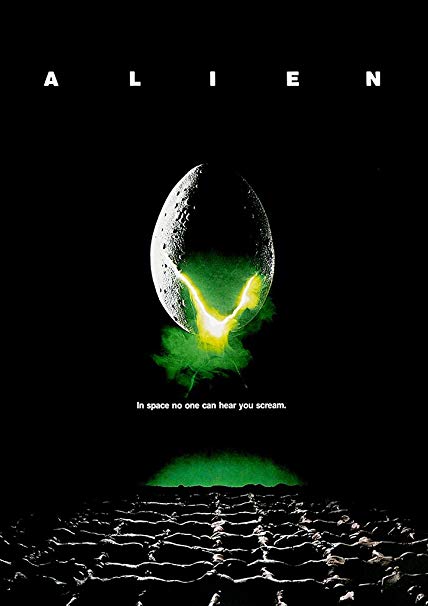 |
| Fig 1. Alien Poster (1979) |
 |
| Fig 2. H. R. Giger (2012) |
 |
| Fig 3. Birth Machine (1967) |
 |
| Fig 4. Necronom IV (1976) |
There are numerous transhuman elements in the film, starting with the alien environment and the space jockey.
 |
| Fig 5. Space Jockey (1979) |
 |
| Fig 6. Xenomorph (2004) |
 |
| Fig 7. Ash (1979) |
Transhumanism is the concept that humanity can evolve. Ridley Scott’s Alien shows a couple paths into that evolution with the Xenomorph and with Ash, while H.R. Giger’s work shows a possible relationship between human and machine.
Bibliography
Bellot, G. (2017) Transhumanism: More Nightmare Than Dream? [Online] At: https://lithub.com/transhumanism-more-nightmare-than-dream/ (Accessed on 8th December 2018)
Bostrom, N (2005) A History of Transhumanist Thought [Online] At: https://nickbostrom.com/papers/history.pdf (Accessed on 8th December 2018) H.R. Giger (1996) At: http://www.hrgiger.com/ (Accessed on 8th December 2018) Hughes, J (2004) Citizen Cyborg: Why Democratic Societies Must Respond to the Redesigned Human of the Future.
Huxley, J. (1927) Religion without Revelation [Online] At: https://archive.org/details/in.ernet.dli.2015.90330/page/n5 (Accessed on 8th December 2018)
Illustrations List
Figure 1. Alien Poster (1979) [Poster] At: https://www.amazon.co.uk/Poster-Ridley-Sigourney-Weaver-Ripley/dp/B018YHJU4W (Accessed on 08.12.18)
Figure 2. Belz, M. (2012) H. R. Giger [Photograph; Close up] At: https://upload.wikimedia.org/wikipedia/commons/9/92/HR_Giger_2012.jpg (Accessed on 08.12.18)

Figure 3. Giger, H. (1967) Birth Machine. [Art] At: https://www.allposters.com/-sp/Birth-Machine-Posters_i9588836_.htm (Accessed on 08.12.18)
Figure 4. Giger, H. (1976) Necronom IV [Art] At: http://alienexplorations.blogspot.com/1979/04/development-of-necronom-iv.html (Accessed on 08.12.18)
Figure 5. Space Jockey (1979) From: Alien, Directed by Ridley Scott. [Film Still] United Kingdom/United States: 20th Century Fox. At: https://scifi.stackexchange.com/questions/33592/what-happened-to-the-alien-that-came-from-the-space-jockey
(Accessed on 08.12.18)
Figure 6. Xenomorph (2004) From: Alien vs. Predator, Directed by: Paul W. S. Anderson. [Promotional Image] United States: 20th Century Fox. At: https://upload.wikimedia.org/wikipedia/en/2/26/Alien_vs._Predator_%282004%29_-_Alien.jpg (Accessed on 08.12.18)

Figure 7. Ash (1979) From: Alien, Directed by Ridley Scott. [Film Still] United Kingdom/United States: 20th Century Fox. At: http://avp.wikia.com/wiki/Ash (Accessed on 08.12.18)
Film Review: Edward Scissorhands
Tim Burton's Edward Scissorhands (1990) is a film that shows a very clear divide between the perfect American suburb and a character that is 'other'. This review will be delving into the American dream, specifically the nuclear family, and how Edward Scissorhands, as a character, doesn't fit into it. Key sources include: James Truslow Adams' The Epic of America (1931), Graeme Harper and Jonathan Rayner's Cinema and Landscape (2010) and Carley Tauchert's Revisiting Tim Burton’s Edward Scissorhands (2009). The key points of this review are: What is the American dream? What is a nuclear family? How do these appear in Edward Scissorhands? and how does Edward contrast this ideology?
The American dream is a concept held in the United States that makes people believe that they can achieve anything. "The American Dream is that dream of a land in which life should be better and richer and fuller for everyone, with opportunity for each according to ability or achievement.” (Adams, 1931: 214) The basic idea of the American dream is that all Americans should be able to achieve their ambitions if they can earn them. This ideology came into existence in the 19th century as the California Dream, it was then expanded upon, renamed and popularised by, writer, James Truslow Adams in 1931. The American dream was used as an opposite for concepts like Soviet Communism and quickly became the foundation for what American life should be. With this came a want for individuality and the normalisation of the 'traditional' nuclear family.
A nuclear family is defined as a family unit consisting of two parents and at least one child. In recent years, this definition includes multiple additions: the parents are not required to be married, they can be a same-sex couple and the children can be in the family by adoption(Encyclopaedia Britannica, 2015). However, when the American dream was popular, this definition was much more restrictive; Two married parents of opposite gender and their biological children. During Cold War America this version of the nuclear family became a common goal, along with moving into peaceful and friendly suburbs.
This structure can be seen in Edward Scissorhands.
Edward Scissorhands is a film about an artificial human, named Edward, being taken into a family in the American suburbs. At first the inhabitants take a liking to Edward, however they turn on him by the end of the film and he flees back up to his castle.
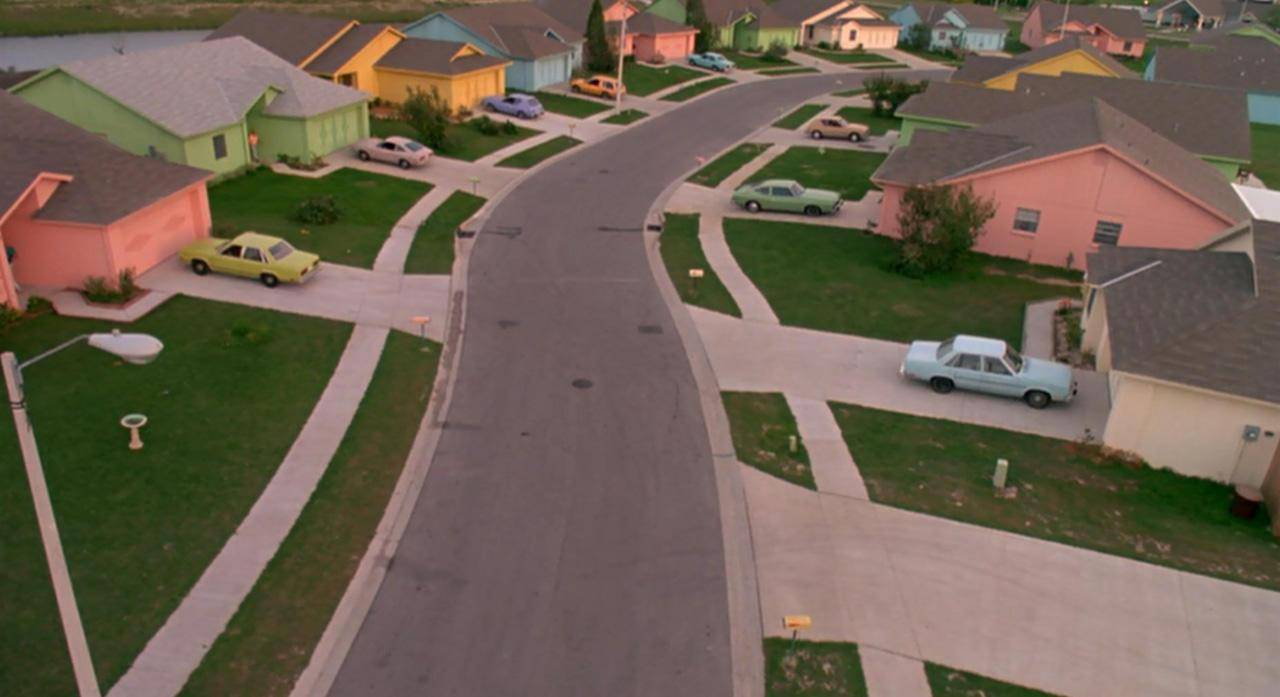
The suburbs in Edward Scissorhands show the American dream's version American life. “American suburban life has also been criticized for its ‘conformity and sterility’, the ‘anomic life of the nuclear family’, gendered space and undifferentiated cancerous sprawl. Culturally, suburbs are often centres of consumption for the products of the city. Edward Scissorhands brings characteristics of a stereotypical suburban life into sharp relief.” (Harper & Rayner, 2010). Looking at figure 2 and this quote, you can see that America's dream for achievement and individuality is nothing more than an illusion. All of the cars are the same, all the men leave for work at the same time and most of the women are stereotypical housewives; the only sense of 'Individuality' comes from the different colours used to paint the cars and the houses.
The nuclear family is also shown in Edward Scissorhands, mostly with the Boggs family.
The Boggs family is a near perfect example of an American dream nuclear family; a working father, a housewife mother (she does have a job, but she's only seen doing it at the beginning of the film), a two children, specifically one son and one daughter. The system with this family is perfectly in line with American dream, until Peg Boggs (the mother) goes up to an old gothic mansion near the suburbs. While there she finds Edward and decides to bring him home with her. Edward instantly clashes with the old nuclear family dynamic.
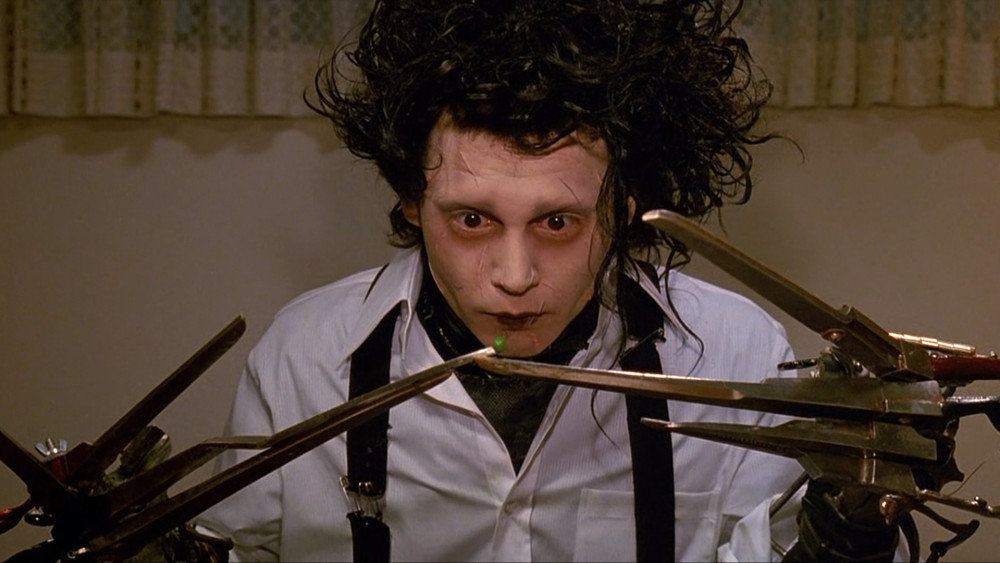
For much of the film, Edward is forced to fit into the neighbourhood. He is forced into normal clothes, he struggles to eat dinner from a plate, he is forced by the men into thinking business. It is pretty clear to the viewer that American conformity is too much for Edward. "A man with the soul of a child, when he first steps into the real world it is a whole new experience for him but his innocence is slowly chipped away, basically by the American dream, the perfect suburb, whose inhabitants are always looking for something new and exciting, but who are easily turned.” (Tauchert, 2009). Edward struggles with fitting in and ends up being painted as a villain by the locals by the end of the film. He feels out of place because he is. He conflicts with the American dream, because he can achieve what the American dream is supposed to.
Edward is a character that can achieve whatever he puts his heart to, he has a strong feeling of individuality and he comes from a family that conflicts with the nuclear family, the single parent.
Edward was created and raised solely by his father, the Inventor, before his death prior to the events of the film (told in flashbacks).
The American dream is a concept created to give American's freedom and individuality, however when confronted by a character with true freedom and individuality, like Edward, people panic and turn against him, favouring the outdated concept. Edward Scissorhands shows the flaws of the American dream by pointing out how restrictive it really is.
Bibliography
Adams, J. (1931) The Epic of America. United States: Simon Publications
Illustrations List
Figure 1. Edward Scissorhands Poster (1990) [Poster] At: https://upload.wikimedia.org/wikipedia/en/3/3b/Edwardscissorhandsposter.JPG (Accessed on 08.12.18)
The American dream is a concept held in the United States that makes people believe that they can achieve anything. "The American Dream is that dream of a land in which life should be better and richer and fuller for everyone, with opportunity for each according to ability or achievement.” (Adams, 1931: 214) The basic idea of the American dream is that all Americans should be able to achieve their ambitions if they can earn them. This ideology came into existence in the 19th century as the California Dream, it was then expanded upon, renamed and popularised by, writer, James Truslow Adams in 1931. The American dream was used as an opposite for concepts like Soviet Communism and quickly became the foundation for what American life should be. With this came a want for individuality and the normalisation of the 'traditional' nuclear family.
A nuclear family is defined as a family unit consisting of two parents and at least one child. In recent years, this definition includes multiple additions: the parents are not required to be married, they can be a same-sex couple and the children can be in the family by adoption(Encyclopaedia Britannica, 2015). However, when the American dream was popular, this definition was much more restrictive; Two married parents of opposite gender and their biological children. During Cold War America this version of the nuclear family became a common goal, along with moving into peaceful and friendly suburbs.
This structure can be seen in Edward Scissorhands.
 |
| Fig 1. Edward Scissorhands Poster (1990) |
 |
| Fig 2. Suburbia (1990) |
The nuclear family is also shown in Edward Scissorhands, mostly with the Boggs family.
 |
| Fig 3. Edward and the Boggs Family (1990) |
 |
| Fig 4. Edward eating peas (1990) |
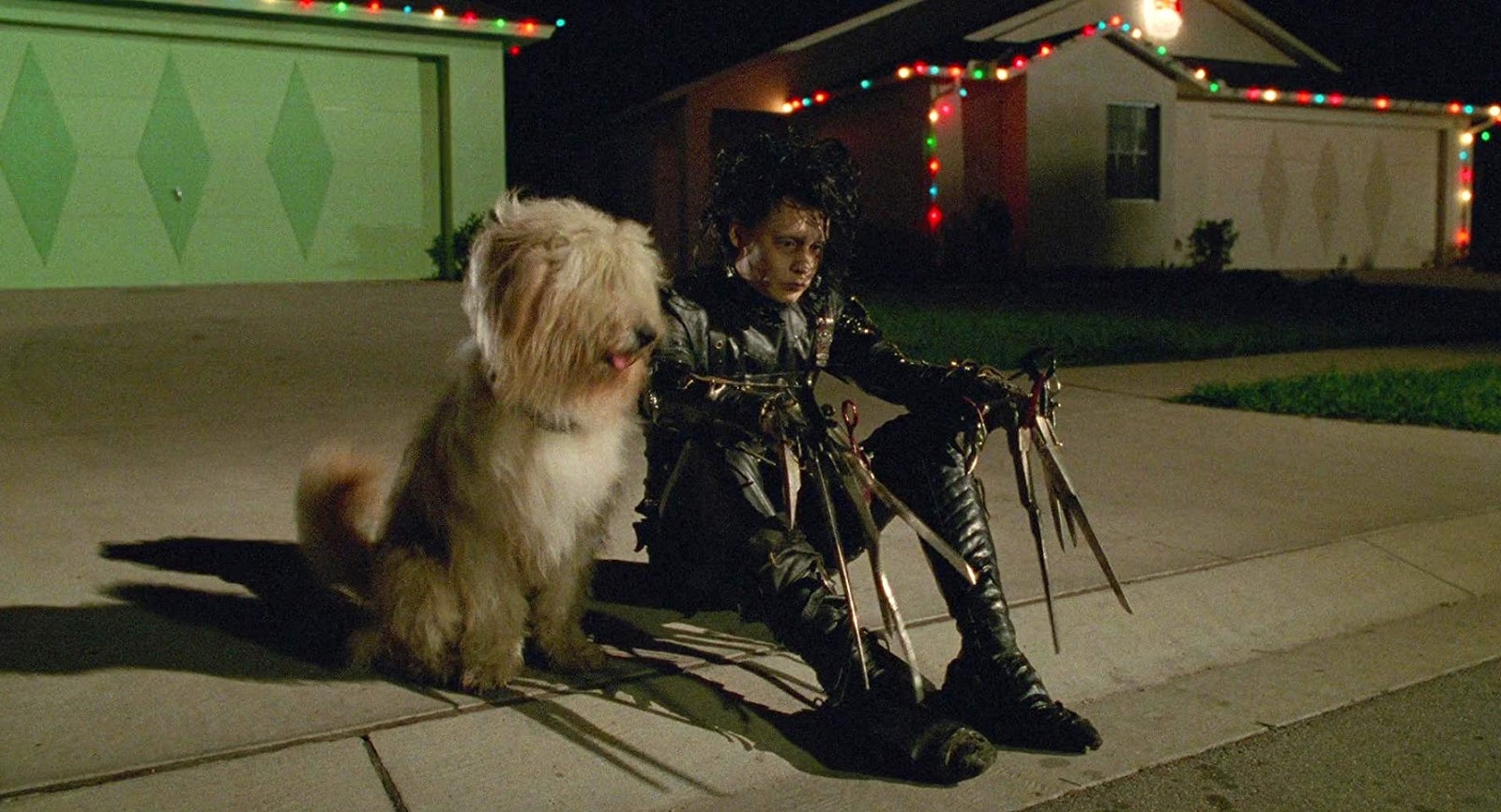
Edward is a character that can achieve whatever he puts his heart to, he has a strong feeling of individuality and he comes from a family that conflicts with the nuclear family, the single parent.
Edward was created and raised solely by his father, the Inventor, before his death prior to the events of the film (told in flashbacks).
 |
| Fig 5. Edward on the side of the road (1990) |
Bibliography
Adams, J. (1931) The Epic of America. United States: Simon Publications
Encyclopaedia Britannica. (2015) Nuclear Family [Online] At: https://www.britannica.com/topic/nuclear-family (Accessed on 8th December 2018)
Harper, G. & Rayner, J. (2010) Cinema and Landscape [Online] At: https://books.google.co.uk/books?id=zA-ngYdpUkIC&pg=PA289&lpg=PA289&dq=nuclear+family+edward+scissorhands&source=bl&ots=94sazGqqtI&sig=09CD85iPzm-jB6uH4f77K3GvErw&hl=en&sa=X&ved=2ahUKEwiAz7eIh5DfAhXZQRUIHXdlBu4Q6AEwDXoECAEQAQ#v=onepage&q=nuclear%20family%20edward%20scissorhands&f=false (Accessed on 8th December 2018)
Illustrations List
Figure 1. Edward Scissorhands Poster (1990) [Poster] At: https://upload.wikimedia.org/wikipedia/en/3/3b/Edwardscissorhandsposter.JPG (Accessed on 08.12.18)

Figure 2. Suburbia (1990) From: Edward Scissorhands, Directed by: Tim Burton. [Film Still] United States: 20th Century Fox. At: https://www.independent.co.uk/arts-entertainment/films/news/heres-what-the-edward-scissorhands-suburb-looks-like-25-years-on-a6763486.html (Accessed on 08.12.18)
Figure 3. Edward and the Boggs Family (1990) From: Edward Scissorhands, Directed by: Tim Burton. [Film Still] United States: 20th Century Fox. At: http://thefancarpet.com/movies/edwardscissorhands/ (Accessed on 08.12.18)
Figure 4. Edward eating peas (1990) From: Edward Scissorhands, Directed by: Tim Burton. [Film Still] United States: 20th Century Fox. At: https://variety.com/2015/film/news/edward-scissorhands-25th-anniversary-johnny-depp-tim-burton-1201653236/ (Accessed on 08.12.18)
Figure 5. Edward on the side of the road (1990) From: Edward Scissorhands, Directed by: Tim Burton. [Film Still] United States: 20th Century Fox. At: https://www.imdb.com/title/tt0099487/mediaviewer/rm3528545024 (Accessed on 08.12.18)
Subscribe to:
Posts (Atom)
-
 I finally got around to updating each of my characters. I wanted to get these all done before I get to work on my animatic. I'm reasona...
 -
With an updated story, I needed an updated script. If any one notices anything that needs to be change or anywhere they think I can improv...
-
 Final year, no graded toolkit, that however doesn't mean the lessons stop. In this first session there was three tasks to do, starting w...